X-Files Alumni.

There’s a lot of great TV kicking around the airwaves (and internet cables) lately.  I always find it pleasantly surprising when I find out an X-Files crew member is involved with one of the newer shows I get into.  Vince Gilligan is probably the most talked about (you know, that little show Breaking Bad?), but there are quite a few other behind the scenes folks involved in a lot of fantastic television making recently.

Kim Manners directed a bunch of Supernatural episodes before he passed away, but before that he directed and produced so many X-Files episodes that I’m not even going to try list them all.  (You can go see for yourself on Manners’ imdb profile.)

I was a late-to-the-party xphile (6th season joiner), but I threw my teenage self into it wholeheartedly.  I’m a little rusty, but even today you could tell me an episode’s title and I could probably give you a complete rundown.  I never knew the last seasons as well as the earlier seasons and there are a few early episodes I was never a huge fan of, but my memory is decent about a lot of the storylines.

Clyde Bruckman’s Final Repose (written by Darin Morgan) is my all time favorite X-Files episode.  Back when Fox had an X-Files fan forum on delphiforums there was a group that ran a list of iconic things that people “claimed” from different episodes.  I was the “owner” of the banana cream pie from Clyde Bruckman’s Final Repose.  It was sort of a silly thing, but silly things are often the best things, and it was a nice way to conceptually connect myself to what I considered X-Files’ finest hour.

I’m also fond of Darin Morgan’s episode Humbug about circus performers, though that could also be attributed to my repressed love of old timey circuses.  (Freaks, my favorite book Nightmare Alley, Carnivale – it’s probably time that I admitted I love the circus?  I still need to read Water for Elephants, though I can definitely say that the movie was a yawn.)

Despite the wonderful surprises of discovering X-Files alumni in current TV favorites, I think the most shocking connection between a TV show writer/director/producer of the 1990s/2000s and present day media belongs to Melissa Rosenberg.  About the same time I fell in love with X-Files I was also crushing on The Magnificent Seven, a late 1990s TV take on the movie of the same name.  Well, Rosenberg wrote the episodes “Witness” and “Working Girls,” (and co-produced several others) but today she is much better known for working on Dexter – and writing The Twilight Saga screenplays!  I definitely did a doubletake on imdb when I saw that.  I’m already a Dexter fan, but I guess I finally have to watch The Twilight Saga.  Sigh.

P.S. The Magnificent Seven was an overlooked and underrated TV series that is worth a viewing.

How a show full of poo jokes motivates me to be myself.

At various points in life I thought I wanted to be a writer, a journalist, an actor, a film director, a history professor, and an archivist.  I think I spent like two weeks (hours?) thinking I’d want to be a computer engineer like my Dad when I was in the single digits age range, but maybe this is just hazy memory and I’m filling in the blanks with something that sounds nice.

In various unofficial capacities I’ve done a little bit of everything on that list (aside from computer engineering).  If you want something badly enough, you’ll find a way to make it happen in some form.  It may not pay your rent, it may not be the ideal dream situation you thought up in the first place, but if you’re so into a particular thing you will make it work in some fashion.

Lately my biggest pet peeve is people talking about what they “really want” and how the world is keeping them from doing what they’re really into.  I try to think up exceptions to this.  Like, say your dream is to be a skydiving champ, but you can’t afford to go skydiving on a regular basis.  But the more I think about it, the more I feel like a person who wants it bad enough will figure out how to earn and save up the money to do it.  It’s all about owning the choices we make and deciding what we’ll sacrifice for the things that really matter to us.

It’s hard to admit this to yourself and the people around you.  It sounds nice to have ambiguous creative goals or lofty career aspirations.  And sometimes it’s hard to figure out what it is that you actually want.  I mean, I don’t think we always know what we’re willing to jump out of a plane for, and that’s where the hang ups are – suspended in mid air, awaiting some kind of landing.

I’m in the process of reevaulating stuff.  As I get older a lot of my earlier wants are still hanging around, but a few other to-dos jumped on the list that are jostling for higher ranking on my life list. I don’t yet know which goal is going to come out on top and serve as my parachute to keep me from splatting on to the earth at a zillion miles an hour.  It’s kinda scary and kind of liberating, but mostly I’m trying to take it as motivation to flex some muscles that’ve been sitting on the back burner.

Watching Workaholics is incredibly motivating.  This might seem like an odd statement for a show with a lot of juvenile humor.  AV Club summed up the jist of the show with: “Workaholics is…about the extended adolescence of post-college life, where an unchallenging first job and the proximity of close friends ease the transition into the real world.”  And in the interview one of the creators really nailed it by saying they “try to be smart in the dumbest way possible.”

The first half of season one isn’t all that great, but it really hits its stride by the end of that first season.  Hilarious.  Originally I was gonna write about how much I relate to this show, even though their biggest demographic is teenage/young adult boys and I’m a closing in on 30-years-old female.  I’ve got a soft spot for any show that privileges buddy relationships over other relationships, they make references to pop culture I grew up with, my first years in LA centered around hanging out at my dude friends’ apartment, I’ve worked an office job just to pay rent, and growing up as a kid in the Bay Area I used to film skits with my friends.

That last point is the motivational point.  The creators of the show spent a couple years making their own videos as Mail Order Comedy before Comedy Central saw their work and funded Workaholics (and even before that they were the kids in school who wrote and filmed their own material for nothing more than their own gratification).  That shit takes motivation, perserverance, and work.  So even though this is a goofy show with a bunch of teenage boy jokes, the guys behind it are hard workers who figured out what they wanted to do and kept at it until something stuck.

Now, not every hard worker is going to see their goal realized with a Comedy Central show (and that’s definitely not my personal goal), but it’s admirable and sorta warm fuzzies to see a group’s determination and work pay off.  The characters they play on the show are ridiculous people, but what Mail Order Comedy achieved professionally is basically a stellar example of “if you want it bad enough you’ll make it work somehow.”  Talk all you want about what you think you want to do, but if you’re not actually doing it or actively sacrificing for it, maybe it’s time to reevaluate what you think you want.

And nobody’s want is any better than anyone else’s want.  It’s hard to not let outside judgement cloud your goals – I am swatting away doubt flies all day, erry day.  If your want is to write skits centered around dick jokes and share them with an audience, that is awesome, because you figured out what you want.  Now, time for me to figure out what my dick jokes are.  I’ve been watching way too much Workaholics (and like a dozen other shows) and not working on my own Workaholics-esque goals.

(I also thought about writing how I intitially dismissed Workaholics and how this show is a great example of why you should never say you don’t like something until you give it a real try.  Man, serious life themes from a very unserious show!  My favorite kind of stuff. (And also why I sometimes still think about heading back to the ivory tower, land of making everything have meaning and piling on the bullshit.  Apparently I am just a crap fan all the way around. (Like how that Sorceress character I wrote as part of an online RPG in junior/high school lived in a tower and now I think about working at a metaphorical tower and maybe life and art have some weird parallels. (Okay, too many tangents.))))

Somewhere Over-the-Rhine-bow

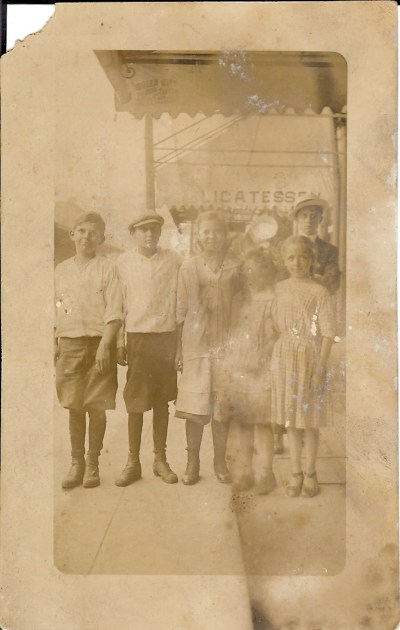
Likely Cincinnati (check out the "Queen City" label on the inside of the overhang).  I think the second kid from the left is probably my great grandpa, but I'm not 100%.

Probably Cincinnati (check out the “Queen City” label on the inside of the overhang). I think the second kid from the left is possibly my great grandpa, but I’m not 100%.

It’s been a number of months and I’m still struggling to write down my impressions of Cincinnati’s Over-the-Rhine neighborhood.  I mostly feel a murky sense of awe at the beautiful architecture and a mix of shame and distress over what kind of living conditions many of the people in the neighborhood deal with on a day to day basis.

In the places we encounter we all bring something to the table.  I’ve lived in Los Angeles for almost six years now.  It is both the richest and poorest place I’ve lived in.  I grew up in the San Francisco Bay Area and was taught that the Bay was beautiful, but LA was a dump.  I’ve always been a fan of the underdog, and now that I’ve been in LA for awhile I feel a sense of ownership and pride and think I can finally call this sprawling metropolis my home and my city.

Downtown Los Angeles has its Skid Row.  It’s a blurry line between bars with $12+ cocktails and industrial streets lined with tents and makeshift shelters.  Well-dressed and high-heeled foodies and cocktail connosseurs cross paths with dishelved individuals who often seem to be aimlessly wandering the streets.  Sometimes you get asked for change, sometimes someone from the tent side of town will try to start a conversation with you (that usually doesn’t make much sense), but as long as you mind your own business the vast majority of encounters with Skid Row residents are passive.

Los Angeles gets such a bad rap for its gang issues, its race riots, its Skid Row.  I’d seen parts of Skid Row enough times at all hours of night and day, so I didn’t think seeing a neglected downtown core in another major city would be any kind of shock, but I think that’s the only word I can use.

I know Cincinnati is a Rust Belt city.  I know Cincinnati has an important significance in the history of my Dad’s dad’s side of the family.  I know when I visited suburban Cincinnati in 2006 all my relatives told me not to go downtown (they all now live in the suburban neighborhoods outside of downtown – no one lives in the city anymore).  Of course that made me want to go even more.

When adult people are slumped over motionless in doorways, it’s easier to distance yourself; to make it a “us” and “them” situation.  We all compartmentalize to some extent as a mental survival mechanism.  The world is full of many things both inside and outside of our control and we place our thoughts and feelings in the bins they need to go in so that we can keep functioning within the narrow scope of our individual lives.

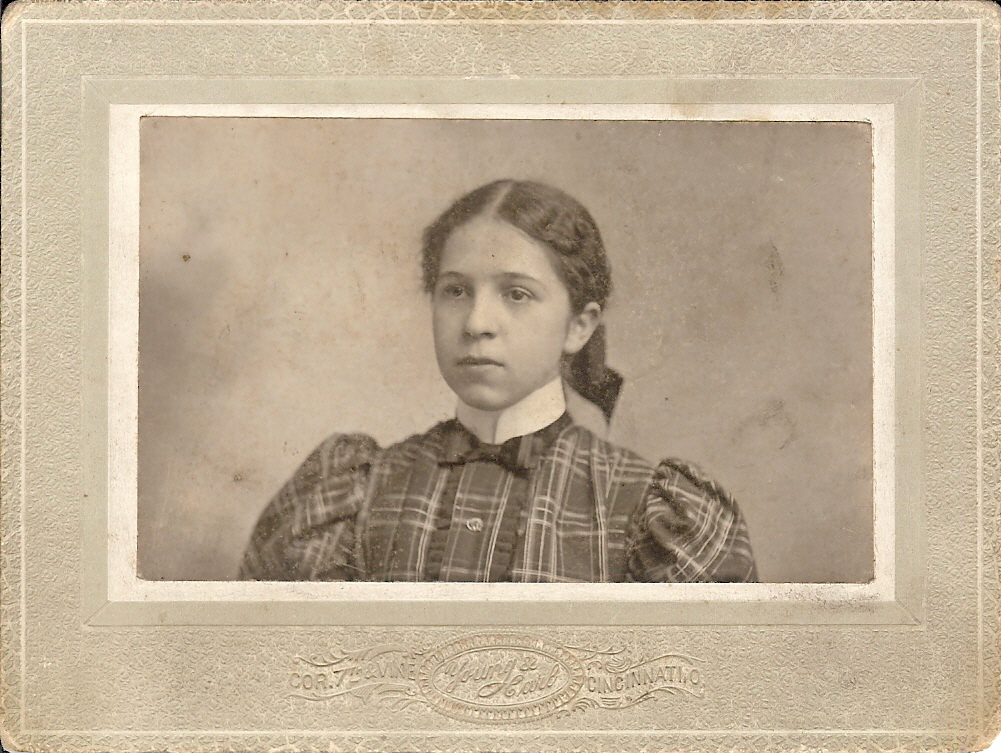
A mystery person (probably a relative) in a photograph taken at a studio at 7th and Vine St. in Cincinnati

A mystery person (probably a relative) in a photograph taken near Over-the-Rhine at Young & Carl photo studio at 7th and Vine St. in Cincinnati (Family Photo Reunion says this studio was in operation at this location between 1895 and 1915)

For months now I’ve placed Over-the-Rhine in its historical bin – a curious look into a past place where my ancestors existed.  Neighborhood neglect has been both a blessing and a curse as many structures still exist, but many are also slowly crumbling away.  Taking a walking tour was a great chance to get to walk the streets my ancestors walked and to see the buildings they saw.  Place is a powerful component of the past.  Getting to see the Over-the-Rhine neighborhood with my own two eyes and feet seemed like the next best thing to climbing in a time machine.  But a very current place exists among the structures of a past time.  While the buildings were neglected and forgotten, so too were the communities that came to live in Over-the-Rhine.

I think that was the biggest shock of the decayed downtown core.  Most of the LA Skid Row individuals I’ve encountered are adults, while walking around Over-the-Rhine felt more like seeing the inside of a multigenerational community existing in spite of human and structural threats.  A group of little kids waved at us from an upper story window, while a gangly woman with a beaten face walked over to a man in a doorway, and a buff weightlifter parked his car along the sidewalk to blast some tunes while he hefted big metal dumbbells on the strip of concrete between sidewalk and asphalt.  This place is alive; people really live here.  (And I don’t mean to knock LA’s Skid Row as a place where people don’t live – it just has a much more transient feel to it, unlike the very rooted feeling of Over-the-Rhine.)

At the beginning of this I mentioned “shame” as one of the feelings percolating in my mind.  I’ve written about the idea of the legacy of historical shame in the past (Legacy Guilt), and I think I’ve come around to a good psychological place on personal genealogical issues.  Despite this, I am still working on finding some level of acceptance in confronting bigger picture injustices that were created by past discrimination and neglect and are perpetuated today.  Like dealing with my personal family history, the bigger family history of humanity (and American humanity in particular) is something that I can’t change.

Maybe at least increasing awareness is a good step in the right direction.  It definitely opened my eyes and made me want to know more, to see more, to understand more.  My inner optimist fell in love with the neighborhood and I feel hopeful that there is some sort of possible middle ground for Over-the-Rhine, where it can keep its roots but become a structurally and culturally safer place for the community to grow.

There are changes and movers and shakers working on the neighborhood, though there is always a fine line between saving buildings and bringing in money and pushing out those that live in the neighborhood.  Can gentrification be a positive for everyone involved?

Boardwalk Empire Odds and Ends.

More stuff floating around in notepads that I wrote during the most recent Boardwalk Empire season:

Textured walls and people in the corner of the frame.  Oh god, I already want to watch last night’s Boardwalk Empire episode again!

Everyone rightfully praises Breaking Bad.  It’s a tightly written story with really deliberate framing of scenes.  When something is put into a shot you know it will have some sort of significance.  It’s that attention to small (usually) inanimate objects that gives the show it’s driving force.  It can be a slow show at times, but you always know there is some sort of payoff waiting at the end of the storyline.

Boardwalk Empire also has a slow, methodical pace punctured by bursts of violent action.  There are more characters and the varied storylines are more dispersed, so the structure of the show is ultimately different.  “Attention to detail” also takes on a different meaning in this 1920s prohibition world.  While Breaking Bad’s contemporary settings are studded with items of interest, the Boardwalk world is an entire scene of detail.

The beginning to this season was especially slow.  At times I wished there were less characters to follow because the first three episodes were like getting the 1924 sampler platter.  Lots of tasty, carefully arranged nibbles that left you looking at the clock, hoping dinner would start soon before your stomach starts eating itself.

Things finally started to roll with “Acres of Diamonds.”  Thought I sometimes think there need to be less characters, I really like the college storyline with Nucky’s nephew.  The collegiate and youth culture of the 1920s is a different landscape that the show hadn’t gone to before.

Historical dramas can occasionally get kind of stagey or look hokey in their costuming and set design.  Part of me wonders what I’m not seeing because I’m a person of 2013, and I’m curious to see how the show looks from the perspective of 2030.  I think it’ll hold up pretty well, but time will tell.

________

Sometimes I think I like all the characters on Boardwalk Empire that all the general internet fans dislike.  I’ve always been a huge Margaret fan (though my fandom did lapse a bit went she went all Catholic guilt churchy).  This season I actually like the Willie storyline.  It’s fun to go inside the 1920s collegiate world, and Willie is a great contrast with Jimmy Darmody.

Sure, Jimmy had a partial college experience, but the flashbacks to his college storyline in the 1910s presented a very different atmosphere.  He left college for the hardknocks Army school and lived through terrible World War I battles that scarred him emotionally and physically.  Even before he joined the military he had a crazy upbringing with very, ermph, untraditional family relationships.

On the other side of the coin, Willie was born into a powerful rich family.  Though his dad Eli hasn’t exactly been father of the year material, he has always had a mom and dad in some fashion, as well as a herd of siblings.  He grew up in a nice home and got to go to a nice college because his family had the leverage and bucks.  Not his fractured adopted family, but his own flesh and blood, as an earlier episode this season reminded us.

Both characters leave college against the wish of elder Thompsons, but their motivations for leaving have a lot to say about the differences in their characters.  Willie poisons and accidentally kills a fellow classmate over some immature teasing.  He was publically embarrassed and rather than live through the embarrassment and move on, he takes it extremely personally and wants a public show of revenge.  He clearly has a sense of entitlement.  He knows which family he comes from, and he doesn’t consider the consequences of his actions because he has the Thompson family safety net.

Jimmy’s safety net was always tenuous.  Even though he had Nucky as ally, they weren’t related, and his life never had any truly reliable family members.  When he went off to fight in WWI he needed an escape, and he made his reckless decision fully aware that it could be his death.  WWI served as Jimmy’s emotional death, and it only took a few mistakes before Nucky made it his physical death too.  The brutal and violent physicality of Jimmy is a manifestation of all the wrongs he was served in life and how his connection with reality and security was tenuous from birth.

I don’t think Willie thought of poisoning his enemy, leaving college, and pegging the murder on his friend and roommate as a death sentence.  I don’t think he realized the levity of his actions until after they occurred, while I think Jimmy was fully conscious that his decisions placed him on a death tightrope.  Willie doesn’t seem to have that same suicidal bent.

Willie seems to embody the roaring twenties cliches more than Jimmy.  To me, Jimmy was always a product or embodiment of the legacy of modern warfare and a domestic byproduct of late 19th century machine boss politics.  His life had more to say about the 1900s and 1910s.

Willie’s a spoiled rich kid who seems to think the world owes him something.  Even though Nucky gives him Ragged Dick, I don’t think he’s going to take Horatio Alger to heart – the 1920s ethos is to get rich quick and have a good time in the city.  Though willie says he wants to work hard and earn his way in life, the Alger protagonist is a hero for older generations.  It’s only a matter of time before Willie gets swept up into mess of the 1920s and his personal Great Depression hits.

As I said earlier, I do like the Willie character, and part of me hopes that he turns out to be a stronger presence and less of a pawn for sussing out the Nucky and Eli relationship.

Ancestors, childhood, and abortion.

When researching genealogy, documenting siblings of direct ancestors and the siblings’ children has proven very helpful in finding clues to the whereabouts of my direct ancestors. Though researching the many siblings in large ancestral family groups is also often an old timey reality check. My modern self starts all enthusiastic about tracking down the husbands, wives, and children, only to realize that my ancestor’s sibling died at 10 or 8 or 15 or 1. One of the saddest things is realizing that some families lost half of their children before those kids even had a shot at adulthood.

As a history person the news isn’t surprising. I know that people died young of all sorts of diseases and accidents and general tough living, but seeing it in your own family, giving names and lives to these individuals, makes the statistics people. It makes me realize how lucky we are in the U.S. in 2013. Yeah, people die of curable things because our healthcare system isn’t, erm, optimally run (totally different topic), but when I think of all the families I know with living children – well, this sure isn’t rural Tennessee in 1798!

It is a rarer tragedy when children get sick, and the families I know haven’t lost half their brood to disease or other causes. This makes me think about how our attitudes toward childhood and children are shaped by the expectation that children will make it to adulthood, and how this might inform modern day attitudes toward abortion.

I recently watched a couple documentaries on abortion. The fervent anti-abortion protestors standing outside clinics were most often portrayed as religiously motivated. I have no doubt that religion plays a major role in many individual attitudes on the subject, but the religious fixation of the anti-abortion protestors made me wonder less about biblical rationales and more about other cultural factors that play into American attitudes toward abortion. You don’t have to be super religious or non-religious to have an opinion on the subject. Separate from religious views, how might a modern day American’s worldview impact their attitudes on abortion?  Is it possible to separate religion from the issue?

Retrospect is often shrouded in a glowy halo. Not everyone I know loved childhood, but I think the general American cultural attitude privileges childhood as some sort of sacred phase. When you privilege the phase of life known as “childhood” as something special, memorable, and innocent, it seems worse to deny this phase to any cell with potential to become a human being.

So though vocal anti-abortion advocates cry foul in the name of religion, could more mild opinions be shaped by the value we place on childhood and optimistic beliefs that our modern medicine can solve the woes of childhood disease and award everyone the opportunity to grow to a fulfilling adulthood? Is it harder for modern Americans to accept that sometimes a fetus that doesn’t develop properly or is impeded by incurable disease has no fighting chance?

And this is not to say that the death of children in any time period is ever an easy thing (my great great great grandparents Thomas Crutcher and Nancy Holt each wrote a mourning poem when their son died in 1865), but I wonder if we’ve forgotten how to accept and mourn death with our overly optimistic rosy lenses – visions of cute children playing in the pages of Toys ‘R’ Us ads and in new clothes for the first day of school override images of infants hooked up on life support systems in the few months before they pass or (in abortions based on choice and not on medical conditions) children put in the adoption/foster system or children kept and not given the developmental support of their peers due to poor financial or emotional environments?

The history of American childhood, abortion, and death and mourning are not my specialties, so I could probably use some more reading before coming to any sort of real conclusions, but I do know enough to at least ask questions and wonder.

(As an aside, I’ll also note that I’m super impressed how old some of my ancestors got – 70s, 80s, even 90s!)

Me in DNA form.

Freshly opened DNA kit!

Freshly opened DNA kit!

So I decided to spit in a tube, drop it in a mailbox, and get my DNA analyzed via AncestryDNA (the ancestry.com DNA test, not the other one floating around on Groupon).  It was incredibly simple and the results of the test analysis showed up a couple weeks earlier than I’d anticipated.  Win, win, win.

1. Spit in tube after not eating for awhile.

20130925_175140_resized

Drooool. (After at least 30 minutes of not eating – don’t want to contaminate your precious cargo.)

2. Close tube cap and release spit DNA preservation stuff.  Oooo, it’s blue!

20130925_175404_resized

Spit enhanced by blue preservation substance.

3. Remove tube funnel and screw on the tube cap.  Place the tube in the biohazard envelope.  Oooo, your spit is a biohazard!

Radioactive....but not.

Radioactive….but not.

4. Place the tube+envelope in the mailer and drop it off at your nearest postal pick-up locale.

Have a safe trip little vial of spit!

Have a safe trip little vial of spit!

5. Wait as patiently as possible. (taps foot -> tap, tap, tap, tap)

6.  Get extremely excited when an e-mail shows up in your inbox announcing your results are ready!  Whoo!

ethnicitybreakdown

Me in regional DNA estimate form.  It’s like my high-tech selfie.  Oooo, I feel so exposed. (P.S. This is much more readable if you click the image and plaster it across your monitor.)

For the most part I found what I was expecting to find.  I really hoped I was at least a dash American Indian, so that was an exciting find.  The trace of Asia Central was unexpected but not entirely surprising.  The most surprising was the 9% estimate for Iberian Peninsula.

On my paternal side I’m Japanese and a mishmash of European – German, French, Irish, and English mostly.  These ancestors lived in the Ohio/Kentucky/Pennsylvania/Maryland region.

On the maternal side I’m half Eastern European (Polish and Slovene) and a mishmash of European.  I’m still working on researching back further, but so far the European side seems likely to be English/Scottish/Irish.  This group of Euro settlers mostly began in North Carolina, migrated to Tennessee, and then later to Texas and Oklahoma.

I’m really not sure which side (or both?) the Iberian peninsula comes from!  I thought maybe it could be southern France, but the last French ancestor I had intermarried into other communities back in the 1700s, so 9% seemed a little excessive for such a distant ancestor.  I’m also not sure where in France my ancestor came from.  We (the family in general) are pretty certain our French ancestor was Huguenot – I’m not sure if this could have some contribution to the mystery.

My actual initial thought was that there was maybe a connection to Slovenia.  It’s a bit of a leap maybe, but in non-DNA percentages I’m 25% Eastern European, so initially I looked to the other percentages to see why the Eastern European estimate was so low.  The more I think about it, the more obscure this connection seems.  I haven’t found any evidence to back up this knee-jerk theory.  I know the DNA that gets passed down to you doesn’t split 50/50 from each parent and I really don’t know if my Eastern European ancestors moved around a bunch in the past couple hundred years.  I just know that they lived in those particular countries before coming to the U.S. circa 1900.

I also read some stuff online about a possible migratory connection between the Iberian peninsula and Ireland, leaving it possible that a couple of my Irish ancestors might have lived on the Iberian peninsula at one point?  I’m not sure.  I need to do some more reading and researching.  I just feel pretty certain that there isn’t a hidden recent ancestor from Portugal/Spain/Southern France/Northern Africa.  But universe, go ahead and surprise me!

I don’t have any documentation of Scandinavian relatives on either side of the family, but I imagine that has something to do with the migration of Scandinavian groups to the British Isles way back in old timey Viking days.  That seems like a pretty straightforward possibility.  Dang, Britain and Western Europe have a pretty strong showing.  Makes sense, but just looks like such a big number to have all those odds and ends of British and Western European ancestors grouped in one percentage.  I don’t tend to think of that part of my ancestry as cohesive since they’ve all been in the U.S. for so long – I tend to think more distinctly about the cultural/ethnic identities of my 20th century immigrant ancestors.

My Mom tells me her dad (of the generally North Carolina->Tennessee->Texas/Oklahoma branch) always said he was “‘Merican” when asked what he was.  Ultimately, that is what I am too!  Americans often get a bad rap (that is also often earned), but I’m happy and proud to be one.  Somebody get me a Stars and Stripes to wave!

All in all, totally worth it.  It was my birthday present from my parents and definitely exactly what I wanted.  🙂

How many voters?

I’m trying to find out more about the Hickman family.  My Hickman relatives now live in Oklahoma, but before that they lived in Tennessee.  I was looking at the 1870 federal census record for my gggreat grandpa Zachary Taylor Hickman and decided to take a spin around the census block to check out the neighbors.

His (at the time) future wife Mary Jane White is a tough one to pin down.  So far it appears that after Zachary Taylor Hickman died she married at least two more times.  Did she have a husband before Zachary Taylor?  She was 20 when they married in 1873, so the odds are lower than if she’d been older.

So I’m cruising around District 9, Lawrence, Tennessee in  1870, trying to spot Mary Janes or a White family.  I get to the end of the census District and see this:

Page 14, 1870 census, District 9, Lawrence, TN/Ancestry.com and NARA

Page 14, 1870 census, District 9, Lawrence, TN/Ancestry.com and NARA

Go ahead, blow that up on your computer screen and take a look at those stats.  I hadn’t seen a tally like this before, and maybe it’s because of the census year or the region or just the guy they hired to do the job, or maybe I just haven’t reached the end of enough censuses (censi?).  How about that voter count?  It kind of makes me want to go back through the census and compare the number of adults eligible to vote and the number of actual adults in the area.

But that’s a distraction that’s going to derail me.  I’ve been hot on Mary Jane White’s trail and I’m not ready to give up yet.  It seems like the Hickmans reused names way more often than other family branches.  This is making it really tough to figure out which Lemuel is which, and how the Lemuels connect with the Snowdens (I think they do somewhere along the line, maybe future back than Tennessee?).

Anywhoo, back to the census records.  I just wanted to pop in here real quick to make a note of the nice statistical rundown.

Me and Los Angeles.

I have over a dozen posts sitting unposted and partially written in notepad files in my Dropbox.  Time for some fall cleaning.  Here is one of the more finished posts:

I listen to Camera Obscura because it puts me back on a train in England. Sheep. Little green hills. The feeling of going.

I left my heart in San Francisco, but found a new one in Los Angeles.

My Los Angeles is not the same as their Los Angeles.  I realized that one of the things I love most about this place is that it it is ultimately mine.  Even though I share it with others and our experiences intersect like circles from a Venn diagram, there is always that part of me that doesn’t touch anyone else.  Just me and LA.

I think I finally decided I was an LA resident when I flew back from my parents house with a carry on bag packed with the favorite books of my childhood.  A lot of my stuff is in a crawlspace at my parents’ house in a city I never really lived in.  It’s left there for the day I “settle down,” if there is ever such a thing.  There is still a lot in the crawlspace, but those books are the most valuable things from teenagedom, because they are conduits of ideas and places that I existed in at that point in time.

I finally became a grown up here.  I put nails in walls and hung pictures on them.  No more posters and scraps of paper taped on walls.  Though it took a juvenile move to get me here.

At the end of college I moved down to LA without a job and with only enough savings to pay for a few months of rent.  It was just as the recession got going, but I was unaware of economics and blindly and foolishly optimistic.

A quickly dwindling bank account added too much urgency to my job search, and the only position I could manage to get in a timely fashion was the exact same type of job I did in the summers between high school and college years.  I hoped working as a receptionist at the marketing company would be my foot in the door, but instead I got disillusioned by the size of egos.  The office was up in a high rise building, physically held up by steel and architectual engineering, but figuratively held up by inflated measurements of self worth.  Answering phones and serving coffee to Hollywood types was mentally unchallenging and it soon became clear that these were not my people and there wasn’t any other place for me at that company.

For sanity’s sake I enrolled in an MA program and planned to hold out at the company for just a bit longer so I could squirrel away extra money for school.  It was both fortunate and unfortunate that two months before I planned on quitting, the company laid off about a third of its workforce in order to do some downsizing and restructuring.  I was bummed not to have the extra cash in savings and to be robbed of my chance to quit on my own terms, but also relieved to not have to deal with the tedium anymore.  That summer I had the opportunity to reestablish my worth as a living human being, so in the end things all worked out.  I was relieved.

And like any relationship, my relationship with the city is fluid. I’m still not sure if it’s going to dump me in the next couple months, or if I want to work hard enough to fight to keep our relationship alive.  What is that saying about ships passing in the night?

———-

As a postscript: Since I wrote this post I found out that I’ll probably be here for another year at least.  The romance continues.

Don’t Get Bitten.

Sometimes I wonder if there is danger in reading things I feel such a simpatico relationship with.

I discovered Raymond Carver’s short stories through the Robert Altman film Short Cuts.  There is something so appealingly spare and non-fantastic about Carver’s stories that I find them very easy to sink into.  His characters live through mundane but profound experiences that are so far away from the usual fantasy, sci-fi, and historical that I’m attracted to.  Though the tales deal with relationships and feelings between characters, there is an overlaying emotional detachment that I find appealing.

Despite my interest in Carver’s work, reading his short stories doesn’t lift my spirits.  Instead I find myself simmering in melancholy, flopping around in a pool of muddy feeling.  I wouldn’t call the writing a downer, but a sort of satisfying status quo romp when all I want to do is have a silent tantrum within my own downed emotions.  There is fulfillment in Carver stories, but also an edge of danger.  Heck, maybe that even ups the appeal.

On a college break I started reading Sylvia Plath’s diaries, and I had to stop reading them because they were making me crazy.  I’ve abandoned many books in the past, so it’s not like setting aside her diaries was anything revolutionary, but her ramblings struck such a chord with me that I began to feel myself slip into her despair.

The other month when playing a game I said I’d come back reincarnated as Sylvia Plath – what a terrible answer!  In retrospect I wish I’d said Margaret Sanger or Eleanor Roosevelt, but my first thought was Plath, mostly based on how I became so entwined with the spirit in her diaries.  I want to go back and finish them, but I think I need to make sure I’m in a mentally good place in life first.

I’m not really sure where I was going with this, other than to say that there is both a pleasure and a danger to books.  I usually think of writing as an antidote to ailments, so it’s an inversion of my usual mode of thought to mark good writing as something akin to handling rattlesnakes.  I guess there is a thrill in risking a bite.  I’ll close with one of my favorite quotes (from a tea bag tag):

“Books have the same enemies as people: fire, humidity, animals, weather, and their own content.” – Paul Valery (1871-1945)

The Three Piece Suit.

William Howard Furnier, my paternal great grandpa. , possibly in Cincinnati, likely sometime in the 1910s or 1920s.

William Howard Furnier, my paternal great grandpa. Possibly in Cincinnati, likely sometime in the 1910s or 1920s.

This is my paternal great grandpa William Howard Furnier.  I look at this photo and think, hey, if this were taken in the era of the digital photo they totally would’ve looked at the camera screen and done a second take.  But with this possibly taken in Cincinnati mostly likely in the 1910s or 1920s, great grandpa Howard Furnier was stuck with this eyes shut photo.

But, I digress.  This post is less about my ggrandpa, and more about his attire.  Rewatching Boardwalk Empire made me pay even closer attention to everyone’s clothes, and I am just dying over the three piece suits.  The jacket-pants-vest combo in 1920s wonderfulness is killing me.  I did some google image searching which led me to this fantastic blog with great posts on Jimmy Darmody’s suits (dark pinstripe and blue suit). (Nick Charles has got it goin’ on too.)

Vests and menswear really don’t fit my body type.  Neither does 1920s womenswear, alas.  Thankgoodness me and the Mad Men era get along.

Howard Furnier would’ve been a contemporary to Andrew Holt (all the way over on my Mom’s side of the family).  Andrew was about 10 years older, but they both seem like they were movers and shakers of a sort.  Howard did some amateur boxing in the 1910s and 1920s – exciting!  Totally a future post topic.  I think I’ll be staying in the 1910s/1920s for awhile, I’m getting comfy here.

Not to mention, Howard married my great grandma Edith Graham in Newport, Kentucky in 1929.  I went on an Underground Cincinnati tour, run by the fabulous American Legacy Tours company, and learned they also have a Newport, Kentucky walking tour on gangsters, speakeasies, and all that jazz!  I don’t know when I’ll be back in the Cincinnati area to visit relatives again, but I definitely want to go on the Newport tour next time I’m around town.  I had no idea Newport was a significant place during Prohibition.