Tag Archives: history

Boardwalk Empire Odds and Ends.

More stuff floating around in notepads that I wrote during the most recent Boardwalk Empire season:

Textured walls and people in the corner of the frame.  Oh god, I already want to watch last night’s Boardwalk Empire episode again!

Everyone rightfully praises Breaking Bad.  It’s a tightly written story with really deliberate framing of scenes.  When something is put into a shot you know it will have some sort of significance.  It’s that attention to small (usually) inanimate objects that gives the show it’s driving force.  It can be a slow show at times, but you always know there is some sort of payoff waiting at the end of the storyline.

Boardwalk Empire also has a slow, methodical pace punctured by bursts of violent action.  There are more characters and the varied storylines are more dispersed, so the structure of the show is ultimately different.  “Attention to detail” also takes on a different meaning in this 1920s prohibition world.  While Breaking Bad’s contemporary settings are studded with items of interest, the Boardwalk world is an entire scene of detail.

The beginning to this season was especially slow.  At times I wished there were less characters to follow because the first three episodes were like getting the 1924 sampler platter.  Lots of tasty, carefully arranged nibbles that left you looking at the clock, hoping dinner would start soon before your stomach starts eating itself.

Things finally started to roll with “Acres of Diamonds.”  Thought I sometimes think there need to be less characters, I really like the college storyline with Nucky’s nephew.  The collegiate and youth culture of the 1920s is a different landscape that the show hadn’t gone to before.

Historical dramas can occasionally get kind of stagey or look hokey in their costuming and set design.  Part of me wonders what I’m not seeing because I’m a person of 2013, and I’m curious to see how the show looks from the perspective of 2030.  I think it’ll hold up pretty well, but time will tell.

________

Sometimes I think I like all the characters on Boardwalk Empire that all the general internet fans dislike.  I’ve always been a huge Margaret fan (though my fandom did lapse a bit went she went all Catholic guilt churchy).  This season I actually like the Willie storyline.  It’s fun to go inside the 1920s collegiate world, and Willie is a great contrast with Jimmy Darmody.

Sure, Jimmy had a partial college experience, but the flashbacks to his college storyline in the 1910s presented a very different atmosphere.  He left college for the hardknocks Army school and lived through terrible World War I battles that scarred him emotionally and physically.  Even before he joined the military he had a crazy upbringing with very, ermph, untraditional family relationships.

On the other side of the coin, Willie was born into a powerful rich family.  Though his dad Eli hasn’t exactly been father of the year material, he has always had a mom and dad in some fashion, as well as a herd of siblings.  He grew up in a nice home and got to go to a nice college because his family had the leverage and bucks.  Not his fractured adopted family, but his own flesh and blood, as an earlier episode this season reminded us.

Both characters leave college against the wish of elder Thompsons, but their motivations for leaving have a lot to say about the differences in their characters.  Willie poisons and accidentally kills a fellow classmate over some immature teasing.  He was publically embarrassed and rather than live through the embarrassment and move on, he takes it extremely personally and wants a public show of revenge.  He clearly has a sense of entitlement.  He knows which family he comes from, and he doesn’t consider the consequences of his actions because he has the Thompson family safety net.

Jimmy’s safety net was always tenuous.  Even though he had Nucky as ally, they weren’t related, and his life never had any truly reliable family members.  When he went off to fight in WWI he needed an escape, and he made his reckless decision fully aware that it could be his death.  WWI served as Jimmy’s emotional death, and it only took a few mistakes before Nucky made it his physical death too.  The brutal and violent physicality of Jimmy is a manifestation of all the wrongs he was served in life and how his connection with reality and security was tenuous from birth.

I don’t think Willie thought of poisoning his enemy, leaving college, and pegging the murder on his friend and roommate as a death sentence.  I don’t think he realized the levity of his actions until after they occurred, while I think Jimmy was fully conscious that his decisions placed him on a death tightrope.  Willie doesn’t seem to have that same suicidal bent.

Willie seems to embody the roaring twenties cliches more than Jimmy.  To me, Jimmy was always a product or embodiment of the legacy of modern warfare and a domestic byproduct of late 19th century machine boss politics.  His life had more to say about the 1900s and 1910s.

Willie’s a spoiled rich kid who seems to think the world owes him something.  Even though Nucky gives him Ragged Dick, I don’t think he’s going to take Horatio Alger to heart – the 1920s ethos is to get rich quick and have a good time in the city.  Though willie says he wants to work hard and earn his way in life, the Alger protagonist is a hero for older generations.  It’s only a matter of time before Willie gets swept up into mess of the 1920s and his personal Great Depression hits.

As I said earlier, I do like the Willie character, and part of me hopes that he turns out to be a stronger presence and less of a pawn for sussing out the Nucky and Eli relationship.


Me in DNA form.

Freshly opened DNA kit!

Freshly opened DNA kit!

So I decided to spit in a tube, drop it in a mailbox, and get my DNA analyzed via AncestryDNA (the ancestry.com DNA test, not the other one floating around on Groupon).  It was incredibly simple and the results of the test analysis showed up a couple weeks earlier than I’d anticipated.  Win, win, win.

1. Spit in tube after not eating for awhile.

20130925_175140_resized

Drooool. (After at least 30 minutes of not eating – don’t want to contaminate your precious cargo.)

2. Close tube cap and release spit DNA preservation stuff.  Oooo, it’s blue!

20130925_175404_resized

Spit enhanced by blue preservation substance.

3. Remove tube funnel and screw on the tube cap.  Place the tube in the biohazard envelope.  Oooo, your spit is a biohazard!

Radioactive....but not.

Radioactive….but not.

4. Place the tube+envelope in the mailer and drop it off at your nearest postal pick-up locale.

Have a safe trip little vial of spit!

Have a safe trip little vial of spit!

5. Wait as patiently as possible. (taps foot -> tap, tap, tap, tap)

6.  Get extremely excited when an e-mail shows up in your inbox announcing your results are ready!  Whoo!

ethnicitybreakdown

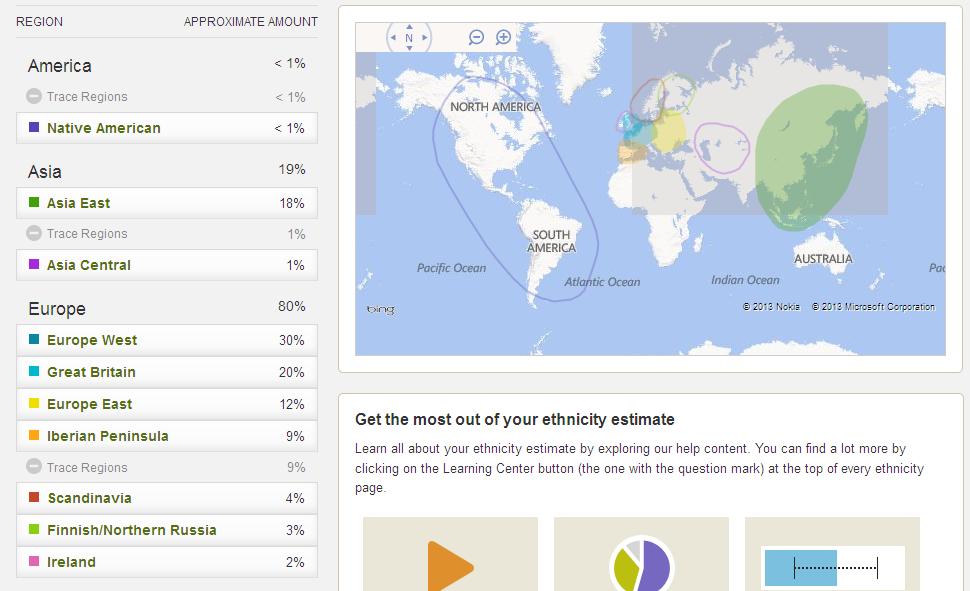
Me in regional DNA estimate form.  It’s like my high-tech selfie.  Oooo, I feel so exposed. (P.S. This is much more readable if you click the image and plaster it across your monitor.)

For the most part I found what I was expecting to find.  I really hoped I was at least a dash American Indian, so that was an exciting find.  The trace of Asia Central was unexpected but not entirely surprising.  The most surprising was the 9% estimate for Iberian Peninsula.

On my paternal side I’m Japanese and a mishmash of European – German, French, Irish, and English mostly.  These ancestors lived in the Ohio/Kentucky/Pennsylvania/Maryland region.

On the maternal side I’m half Eastern European (Polish and Slovene) and a mishmash of European.  I’m still working on researching back further, but so far the European side seems likely to be English/Scottish/Irish.  This group of Euro settlers mostly began in North Carolina, migrated to Tennessee, and then later to Texas and Oklahoma.

I’m really not sure which side (or both?) the Iberian peninsula comes from!  I thought maybe it could be southern France, but the last French ancestor I had intermarried into other communities back in the 1700s, so 9% seemed a little excessive for such a distant ancestor.  I’m also not sure where in France my ancestor came from.  We (the family in general) are pretty certain our French ancestor was Huguenot – I’m not sure if this could have some contribution to the mystery.

My actual initial thought was that there was maybe a connection to Slovenia.  It’s a bit of a leap maybe, but in non-DNA percentages I’m 25% Eastern European, so initially I looked to the other percentages to see why the Eastern European estimate was so low.  The more I think about it, the more obscure this connection seems.  I haven’t found any evidence to back up this knee-jerk theory.  I know the DNA that gets passed down to you doesn’t split 50/50 from each parent and I really don’t know if my Eastern European ancestors moved around a bunch in the past couple hundred years.  I just know that they lived in those particular countries before coming to the U.S. circa 1900.

I also read some stuff online about a possible migratory connection between the Iberian peninsula and Ireland, leaving it possible that a couple of my Irish ancestors might have lived on the Iberian peninsula at one point?  I’m not sure.  I need to do some more reading and researching.  I just feel pretty certain that there isn’t a hidden recent ancestor from Portugal/Spain/Southern France/Northern Africa.  But universe, go ahead and surprise me!

I don’t have any documentation of Scandinavian relatives on either side of the family, but I imagine that has something to do with the migration of Scandinavian groups to the British Isles way back in old timey Viking days.  That seems like a pretty straightforward possibility.  Dang, Britain and Western Europe have a pretty strong showing.  Makes sense, but just looks like such a big number to have all those odds and ends of British and Western European ancestors grouped in one percentage.  I don’t tend to think of that part of my ancestry as cohesive since they’ve all been in the U.S. for so long – I tend to think more distinctly about the cultural/ethnic identities of my 20th century immigrant ancestors.

My Mom tells me her dad (of the generally North Carolina->Tennessee->Texas/Oklahoma branch) always said he was “‘Merican” when asked what he was.  Ultimately, that is what I am too!  Americans often get a bad rap (that is also often earned), but I’m happy and proud to be one.  Somebody get me a Stars and Stripes to wave!

All in all, totally worth it.  It was my birthday present from my parents and definitely exactly what I wanted.  🙂

How many voters?

I’m trying to find out more about the Hickman family.  My Hickman relatives now live in Oklahoma, but before that they lived in Tennessee.  I was looking at the 1870 federal census record for my gggreat grandpa Zachary Taylor Hickman and decided to take a spin around the census block to check out the neighbors.

His (at the time) future wife Mary Jane White is a tough one to pin down.  So far it appears that after Zachary Taylor Hickman died she married at least two more times.  Did she have a husband before Zachary Taylor?  She was 20 when they married in 1873, so the odds are lower than if she’d been older.

So I’m cruising around District 9, Lawrence, Tennessee in  1870, trying to spot Mary Janes or a White family.  I get to the end of the census District and see this:

Page 14, 1870 census, District 9, Lawrence, TN/Ancestry.com and NARA

Page 14, 1870 census, District 9, Lawrence, TN/Ancestry.com and NARA

Go ahead, blow that up on your computer screen and take a look at those stats.  I hadn’t seen a tally like this before, and maybe it’s because of the census year or the region or just the guy they hired to do the job, or maybe I just haven’t reached the end of enough censuses (censi?).  How about that voter count?  It kind of makes me want to go back through the census and compare the number of adults eligible to vote and the number of actual adults in the area.

But that’s a distraction that’s going to derail me.  I’ve been hot on Mary Jane White’s trail and I’m not ready to give up yet.  It seems like the Hickmans reused names way more often than other family branches.  This is making it really tough to figure out which Lemuel is which, and how the Lemuels connect with the Snowdens (I think they do somewhere along the line, maybe future back than Tennessee?).

Anywhoo, back to the census records.  I just wanted to pop in here real quick to make a note of the nice statistical rundown.

Herminie, PA Coal Mining and Ignatz Kolar

The internet is great and constantly updated.  I feel like every year or so I need to re-search the internet for family names and the history of different regions.

scan0003

Rozalija (Rose) and Ignatz (Ignac) Kolar, circa early 1930s

Rozalija and Ignatz Kolar were from Slovenia, or what was then part of Austria-Hungary in the late 19th/early 20th century.  When they first came to the U.S. at the turn of the 20th century, they lived in Herminie, Pennsylvania, outside of Pittsburg.  The region of Slovenia they came from was largely a mining area, and so one of the first jobs Ignac had in the U.S. was a mining job.

I came across the Virtual Museum of Coal Mining in Western Pennsylvania that lists him as a Slovenian miner circa 1912 for the Ocean Coal Company in Herminie, Westmoreland County, Pennsylvania at the Ocean/Herminie No. 1 bituminous coal mine.  Sounds about right to me!

There were coal company owned houses and stores in Herminie, but it looks like my great great grandpa Ignatz owned his own home, or at least rented a non-company house.  On the page about the Ocean/Herminie No. 1 mine, there is a line that notes:

“The first settlers, such as Sornig, Mole Gradisek, Coz, Kolar, Bedek, Kapla, Arnold, Drab and Cirar, have their own homes, but religious conditions are rather bad.

On Sundays many worship in the Irish church of Our Lady in Madison. Once a year Rev. J. Mertelj comes from Pittsburgh to hear confessions. In the village there are the following lodges: SNPJ Lodge #87 which was founded in 1906 with 14 members; St. Barbara’s Lodge, founded in 1908 with 16 members, and SSPZ Lodge founded in 1911 with 17 members. The immigrants came mostly from the Upper Carniola (Gorenjska) or Notranjska and have found work in the coal mines. {from Rev. J.M. Trunk text published originally in 1912 Part 8, History of Slovene Communities.}”

The family eventually purchased a farm and moved to Sheldon, Wisconsin.  I believe the photo above was taken in the early 1930s in Wisconsin.  I’ve never been to Herminie and I’ve never worked in a mine, but I can’t help but imagine that working hard as a farmer was a huge move up from laboring in an early 20th century coal mine.

Grandparents and parents.

File0003

Margaret and Donald Hickman with my Uncle and Mom. February 1959 and probably in Garden Grove, CA

I went to a clothing swap on Saturday that confirmed my belief that 1950s and 1960s dresses are my thing.  I still think the early 1930s are my most favorite fashion years, but I wasn’t built to wear those styles.

I’m glad Don Draper on Mad Men is finally becoming aware of his alcoholism.  My grandpa Don was also an alcoholic in the 1950s and 1960s (and other decades).  I hope Don Draper can move beyond his drinking problem and not let it kill him in the 1980s like it did my Don.

My grandparents lived in Southern California for awhile in their younger years.  Don was a Seabee in the Navy at Port Huaneme (and other non-SoCal locales), and then he and my Grandma lived in Los Angeles and Orange County for a bit before they ended up back in Oklahoma.

I haven’t found documentation, but when Don was a little kid I think his parents brought him out to California at least once in the 1930s.  It seems like he had a very unstable childhood.  I’ve always thought his dad James Aubrey Hickman (who I call “Pa” because that’s what my Mom called him) was handsome in photos.  I think he was also an alcoholic?  Maybe I’ll post about Pa next.

Cover

Machiko and James Furnier with my Dad, circa 1960-1961. Could’ve been taken in Montana or Okinawa or Ohio or elsewhere. I’m sure someone knows where. I should ask.

I didn’t get to know my Furnier grandparents very well before they passed away.  My Grandpa James was big into genealogy, which is one of the few things I know about him.  He did a lot of research on the Furniers, back in the days before the internet.  As genealogy torchbearer I’ve been debating creating some kind of online database with all the genealogy related materials digitized and organized.  I don’t think of myself as owner of any of it; I think of myself as steward of materials that belong to the whole family.

For now I’m just going to start posting more about genealogy on this blog.  It seems to be one of the few subjects I feel inclined to ramble about.  Writer’s block is no match for genealogy musings.

Existence through Time and Space.

Cheerful kitsch in a bulldozed lot in historic downtown Hanford, CA, April 23, 2013

Cheerful kitsch in a bulldozed lot in historic downtown Hanford, CA, April 23, 2013

In the very near future I’ll be heading out on a trip that traverses states and features city and country locales. As I research ideas and plot out plans I’ve realized that there is a very strong link between what I do as part of the daily grind and what I do when I travel. When I’m at work I preserve the paper echos of places that no longer exist, and then when I travel I search for spiritual traces on temporal planes that have moved on to new instances of reality.  I never expect to find what was there before, but I respect the residues of the past and embrace the present energy of a place.

Though I often think of what’s lost to time, I also think of how these spaces are conduits of memory, sending letters in a bottle to the present.  Often the bottles are broken and the letters shredded by time, but fragments remain.  The fragments still tell stories and demonstrate that memory and place are important partners that weave together a human fabric.  How will we wear the fabric woven by past human action and metamorphosed land?  Thinking about the potential fashion of the future gets me jazzed.

Legacy Guilt.

Today I went to the Western History Workshop on Dr. Alice Echols’ work in progress project on her grandfather’s involvement with a Building and Loan Bank scandal in Colorado Springs in the Great Depression.  At the beginning of her presentation she brought up the problematic nature of mining family history for history narratives.  Past lives, like present lives, are riddled with tragedy as much as they are stories of success and triumph.

In my own personal genealogy research I semi-recently learned that my great great great great grandpa was a slave owner in Tennessee.  Most of his sons moved to Texas as young adults and remained there until their deaths.  The sons fought for the Confederacy in the Civil War, while their slave owning father actually sided with the Union.

Thomas Crutcher Holt, one of the sons (and my ancestor) worked as an itinerant Methodist and Baptist preacher in the South.  His son Edgar Eugene Holt moved to southern Oklahoma.  And it was there in southern Oklahoma that Edgar’s son Andrew Holt, my great grandma’s oldest brother, ran whiskey during Prohibition in the 1920s and was shot down by a sheriff (and family oral history also says a U.S. Marshall) in a nighttime raid.

The Morning Tulsa daily world. (Tulsa, Okla.), 21 Jan. 1922. Chronicling America: Historic American Newspapers. Lib. of Congress.

The Morning Tulsa daily world. (Tulsa, Okla.), 21 Jan. 1922. Chronicling America: Historic American Newspapers. Lib. of Congress. http://chroniclingamerica.loc.gov/lccn/sn85042345/1922-01-21/ed-1/seq-5/

I don’t feel bad at all about having a Prohibition violating ancestor, though I do feel a little bad about having a slave owning gggg grandfather.  I’ve decided to call this legacy guilt.  It’s a non-monetary inheritance that you can’t really do anything about.  The longer I’ve known about it the easier it has been to reconcile that what an ancestor did is very much in the past, and what you do as an individual in the present is far more important than the actions of any one of the hundreds of ancestors that rotated around the sun before you.

Their actions had far reaching implications and greatly impacted the lives around them, but there is no remedy for that when you are nothing but an agent of the present.

If anything, learning more about the potentially negatives aspects of my family’s past illuminates a general history narrative that often feels generic and impersonal.  I’ve been pursuing information on the cultural context of my slaveowning ancestor in Tennessee and his sons’ move to Texas.  It’s been an exciting journey so far to try to understand the push and pull factors of their choices through the contexts of their lives.

Support for the National Women’s History Museum

Somehow the National Women’s History Museum got ahold of my mailing address.  I’ve recently been involved with preservation organizations and have given money to the National Trust for Historic Preservation, so I have a feeling they found me through one of those veins.

At first I was unsure how I felt about such a museum.  When I wrote my undergrad thesis I was annoyed that books on women’s history were labeled with pinky-purple stickers marking them as “gender” history books.  They were sequestered on a floor away from the history books and in their own nook next to all the different “studies” books (African-American, Chicano, etc.).  While I think there is nothing more awesome than acknowledgment of women’s achievements throughout the past (or the achievements of any other understudied, marginalized groups), I don’t see why these books can’t rub shoulders with the “non-gendered” history books.  So in this way, my first reaction was to feel that women don’t need an entire museum – they just need greater recognition in the Smithsonian American History Museum.

Yet the more I started thinking about the divergent ways in which women experience and engage with history, the more I started to feel that maybe this wasn’t such a bad idea after all.  While there is something of a collective American experience that affects all residents of the country, there are different expectations for how to fulfill what it means to be an American man or woman.

Senators Jim DeMint from South Carolina and Tom Coburn from Oklahoma essentially crushed the bill put forth to the Senate that would allow federal land near the National Mall to be sold (at fair market value) to the National Women’s History Museum for a museum site.  DeMint and Coburn placed a hold on the bill that stalled its progress until last year’s Congress closed, forcing the supporters of the bill (Senator Carolyn Maloney from New York and Susan Collins from Maine) to reintroduce it again this year.  The objectors’ protests centered around allegations that the museum was a politically driven organization desiring to put up only pro-abortion messages, despite the lack of evidence to prove that this was the case.  The museum will not be receiving taxpayer support, it is a private non-profit, and all it wants to do is purchase land to build a museum.

All this says to me that there is a great need at present for more dialogue on women’s role in history.  When all that can be said about women’s history is abortionabortionabortion there is clearly a need for greater education.  A Women’s History Museum should not just be about birth control and feminism (though these two are important components of a larger story), but should tell all facets of the female experience.  The Museum is currently running (and expanding) an online exhibit about motherhood, which I have a feeling is intended to soothe the naysayers’ worries that the Museum will only celebrate rebellion or stories that might be perceived as “non-traditional” to the more conservative sector.  I applaud the efforts of the exhibit and really hope that it shows how we arrived at our present attitudes and how complicated the choice to be a mother is at present!  Having it “all” seems like a heck of a lot of work and I applaud those who choose motherhood, those who choose careers, and those who tackle them both.

So even though I want to buy an HD TV, I just shelled out a couple hundred for thesis binding/copying/graduation fees, my car needs new break pads, and I just had my giant car insurance bill arrive in the mail, I’m going to get out my checkbook and send in some monetary support.  And if someone were to send me a call for support for a National Men’s History Museum, I’d jump on board there too.  I think what it means to be a “woman” or a “man” in any given time period is very important in discerning how we choose to act and shape ourselves.  I don’t think women should be privileged over men by any means (or vice versa), we just need to reach a greater level of understanding and respect for all conditions of life.  I think that the National Women’s History Museum is a good way to do just that.

More info on the museum at their website.

Folks.

I am fascinated with the early 20th century west and midwest.  The dusty lonesome farmer, the wanderer, set against an unceasing landscape.  An individual who either bucks community or searches for it – or sometimes both.  A closed frontier and questions of where to go next.  The newly domesticated.  Or at that, the fear of the new.  Having everything in the world seemingly open to you, but the closeness of community to keep an individual from being able to stray from accepted conventions.  It is a crossroads, a meeting place.  The landscape of the immigrant and of the disadvantaged.  A natural landscape with humans struggling to get ahead to the unnatural.  Fascinating.

Part of my fascination with it is also my personal connection to it.  My Dad’s family were early Ohio pioneers.  Today that is barely the midwest, but in 1800 (when they made their way out there) it was the edge of the American world.  My Mom’s family went into Oklahoma after the land was opened up to white settlers.  Every generation on my Mom’s side in the 20th century migrated to California to live for a period of time for various and sundry – though they have all left California by now (Except me!  Though I’ve never lived in OK).  The road between Oklahoma and California is a well-worn one for my Mom’s folks.  None of my American ancestors come from rich families.  We’ve always been average Joes, more or less.

This is instigated by working at a museum focusing on Western culture, and also on some rewatching of Carnivale.  I love the texture of Carnivale – the dark, dusty, worn texture.  I want to curl up in it.

Extraordinary Traveler.

Whew, I’m nearing the end of the semester!  Come on Christmas!


Burton Holmes

So I’ve become a big fan of this guy – travel lecturer, early film pioneer, and all around a likeable guy – based off of his autobiography The World is Mine.  Now, with a title like that you’d think he was completely full of himself, and perhaps he was, but it doesn’t come off that way in his writing.  He was born in 1870, began giving travel lectures accompanied by magic lantern slides in the late 19th century, and then went into travel film making.

He comes out of the Victorian era, though his perspective on religion when he was close to death in the 1950s is so enlightened and modern, even for the 1950s.  He discusses his thoughts on existence, his desire to believe in reincarnation, his unsureness in everything, yet his faith in the general universe.  A refreshing surprise and a welcome perspective.

His travel work is fascinating as well – he really traveled everywhere!  I’ve only looked at his work in England to this point (for my class paper), but I’ll definitely be having a look-see at his other travel work.

More wonderful tidbits on this under-talked-about travel icon can be found at this great site: Burton Holmes, Extraordinary Traveler.

Next on the plate: The representation of Dolores Del Rio and Lupe Velez in Photoplay magazine in the early 1930s.  I’ve got a mini presentation to give on the topic tomorrow – details to follow once I figure them out, eep.