Tag Archives: Love County

Julia Holt, Student Government and Basketball Leader

So many of my genealogical musings have centered either on navel gazing or on highlighting the sensational. When looking for ancestral bread crumb trails, it’s much easier to find a newspaper article decrying violence, drug use, or some other kind of debauchery. Occasionally there is a social note that reads like old-school Facebook (Mrs. So-and-so went to the neighboring town on Saturday for a picnic and a visit to Mrs. This-and-that). But the bits that have a little more meat to chew on are the series of articles about a shooting, or an arrest, or something along those lines with a point of debate. (Did it really happen that way??)

I’ve spent a lot of time gathering info on what happened to Andrew Holt, because it’s low-hanging fruit and plays into a true crime sort of interest, as well as an interest I have in understanding what it was like to live in Oklahoma’s Love County and Carter County in the early 20th century. What was life like on that part of the Red River straddled by Texas and Oklahoma? What led people to make choices or be impacted by a system that led them to be sensationalized in the newspaper?

The last few years of my personal life have been really packed with living in the present, so I haven’t had a lot of time to muse in the past lately. But I do have just a few moments now to pick up something I was working on a few years ago when I came across a whole series of newspaper nibbles that have an entirely positive angle. In the early 20th century The Marietta Herald had sections with local town news, including Greenville, Love County, Oklahoma. And in these pages I see a piece of an ancestor that I’ve heard so many stories about – yet there is still more to learn about who she was.

Nannie who had red hair and a love of flowers. Nannie who married and divorced my great grandpa twice, and then was buried next to her friend Woodrow. Nannie who sold Studio Girl cosmetics. Nannie who went to almost all my Mom’s basketball games growing up. Nannie who cared for everyone.

I have fuzzy childhood memories of visiting Nannie when I was young, before she passed away in 2003. Since then she’s lived on in stories from my own Mom and Grandma, and others in our family who also have living memories of her. But there’s also a part of Nannie, of Julia Holt, in the newspaper that is not sensational, but is also so us, in her work ethic, in her activities, in her organizing. And part of processing the complicated past is not only engaging with the family history true crime genre. There are past things to reckon with, but there are also people to love.

In the Marietta Monitor Greenville section, Nannie is listed as sophomore class Vice President in December 1928. She was also the basketball team captain for at least two years. Commenting on the captains, the Monitor said, “Good leaders mean much for any activity. It would be hard to find better sports than Sam [the boys team captain] and Julia.” (She was guard on the basketball team, which makes sense based on how tall our family is, hah!) The following year Julia was class Secretary, and as a senior she was once again Vice President.

As a kid I organized clubs in elementary school, then volunteered and ran for high school student government. Now I volunteer for professional society committee leadership. And here is my great grandma, doing this almost 100 years ago! 

While Julia’s older brother Andrew Holt became tangled up with prohibition, alcohol, and law enforcement, his little sister led in student government and basketball. I won’t stop exploring the challenging dark parts of the past, but there is also a need to highlight the good. And know that nothing is absolute – acknowleding the good is not erasing the dark, and vice versa. Like most everything else, the past is complicated. There’s more of mine to mine in the Marietta Monitor, but that’s all the time I have to muse about the past today.
Oklahoma and prohibition

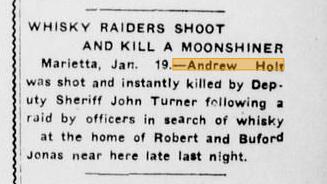
I’ve been a little fixated on my ancestor Andrew Holt lately, mostly because it’s been relatively easy to find a couple newspaper articles on his death.  Since I posted the last article I came across more newspaper bits that relate to him.  On one hand I’d like to pick a more obscure relative to research, but obscurity often doesn’t leave a very obvious paper trail, so for now pardon my obsession with the bootlegging/Prohibition related relative.  I’ll do my best not to glorify or harangue any of the participants too much.

My great grandma Julia Holt Hickman's oldest brother in the papers.  Oklahoma Weekly Leader, 1922 January 19.

My great grandma Julia Holt Hickman’s oldest brother in the papers. Oklahoma Weekly Leader, 1922 January 19.

I picked up a book on Prohibition in Oklahoma called Born Sober: Prohibition in Oklahoma, 1907-59 by Jimmie Lewis Franklin, published in 1971.  Before big “P” federal Prohibition was passed and went into effect in 1920, Oklahoma had little “p” prohibition.  Before statehood Oklahoma was divided between Indian Territory and Oklahoma Territory.  Indian Territory was always dry, and when Oklahoma became a state in 1907 (uniting the two territories), it too went dry.

Born Sober mentions a saloonkeeper in Ponca City, who reacted to statewide prohibition by posting this statement above his business, “Hush little saloon, don’t you cry; you’ll be a drug store, by and by.” (Franklin 24)  I wish the book had more tasty tidbits like that.  It’s a great statewide overview, but leans more toward political machinations than cultural history.  I also think there is something to be said about race and alcohol prohibition, but maybe someone else wrote that book between 1971 and the present day.  I haven’t done any research on that yet.

I do give the author props for at least touching on the role of religion in the prohibition debate.  Catholics (often more recent immigrants) were sacramental wine users, while Protestants (who made up the majority of Oklahomans at the time) didn’t need booze to satisfy the rituals of their religious practice, and were more likely to be vehemently anti-booze.  For the record, my Oklahoma relatives were somewhere in the Methodist-Episcopal-Baptist range.  Andrew Holt’s grandpa was itinerant minister Thomas Crutcher Holt.  T.C. Holt  is an entire series of posts on his own, so I’ll leave that there for now.

Anywhoo, statewide prohibition was difficult to enforce (hey, just like federal Prohibition a decade or so later).  Local sentiment played a big role in whether or not enforcement was feasible in particular regions.  It was also expensive to enforce and difficult to control liquor coming over the border from wet states. (Franklin 37-40).  Despite enforcement difficulties and attempts to amend or do away with prohibition of alcohol in Oklahoma, the statewide ban remained.

There are some nitty gritty details on the particulars of alcohol prohibition – things like adjustments in the enforcement of the law, restrictions, and the exception that allowed individuals to get a prescription for alcohol from their doctor.  There is also a lot to be said about the background of the whites who moved to Oklahoma before and after statehood, and how that came into play in terms of the political power dynamics.  And, even after federal Prohibition ended in the early 1930s, Oklahoma still had another form of state alcohol prohibition.

For family history purposes in this particular case study I’m going to stick to the 1900-1933 period and keep it general unless it directly pertains to my family in Love County.  I’m mostly interested in better understanding the context of the 1922 shooting of my relative Andrew Holt in Marietta, OK, and any other info is bonus material.

I really hope someone has a picture of him somewhere.  I’d love to put a face with a name.  I do have several pictures of his youngest sister, my great grandma Julia Holt Hickman.  She died when I was young, but I did get to meet her on several occasions.  My Mom was really close to her and has told me a lot of very nice things about her, so I’ll have to do a post on her sometime.

(Researching alcohol prohibition has been a nice build up to the Boardwalk Empire premiere in September!  I can’t wait.  It’s like a birthday present to me – sensationalized history with some of the best costuming and set design.  And the music!  Only place on modern TV to have 1920s dance tunes show up that I can sing along to.  I’m still ecstatic “Barney Google” was at the end of last season……”with the goo goo googly eyes….”  So cool.)