Oklahoma and prohibition

I’ve been a little fixated on my ancestor Andrew Holt lately, mostly because it’s been relatively easy to find a couple newspaper articles on his death.  Since I posted the last article I came across more newspaper bits that relate to him.  On one hand I’d like to pick a more obscure relative to research, but obscurity often doesn’t leave a very obvious paper trail, so for now pardon my obsession with the bootlegging/Prohibition related relative.  I’ll do my best not to glorify or harangue any of the participants too much.
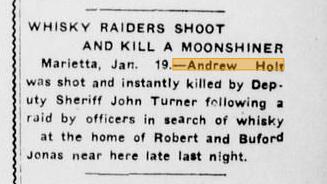
My great grandma Julia Holt Hickman's oldest brother in the papers.  Oklahoma Weekly Leader, 1922 January 19.

My great grandma Julia Holt Hickman’s oldest brother in the papers. Oklahoma Weekly Leader, 1922 January 19.

I picked up a book on Prohibition in Oklahoma called Born Sober: Prohibition in Oklahoma, 1907-59 by Jimmie Lewis Franklin, published in 1971.  Before big “P” federal Prohibition was passed and went into effect in 1920, Oklahoma had little “p” prohibition.  Before statehood Oklahoma was divided between Indian Territory and Oklahoma Territory.  Indian Territory was always dry, and when Oklahoma became a state in 1907 (uniting the two territories), it too went dry.

Born Sober mentions a saloonkeeper in Ponca City, who reacted to statewide prohibition by posting this statement above his business, “Hush little saloon, don’t you cry; you’ll be a drug store, by and by.” (Franklin 24)  I wish the book had more tasty tidbits like that.  It’s a great statewide overview, but leans more toward political machinations than cultural history.  I also think there is something to be said about race and alcohol prohibition, but maybe someone else wrote that book between 1971 and the present day.  I haven’t done any research on that yet.

I do give the author props for at least touching on the role of religion in the prohibition debate.  Catholics (often more recent immigrants) were sacramental wine users, while Protestants (who made up the majority of Oklahomans at the time) didn’t need booze to satisfy the rituals of their religious practice, and were more likely to be vehemently anti-booze.  For the record, my Oklahoma relatives were somewhere in the Methodist-Episcopal-Baptist range.  Andrew Holt’s grandpa was itinerant minister Thomas Crutcher Holt.  T.C. Holt  is an entire series of posts on his own, so I’ll leave that there for now.

Anywhoo, statewide prohibition was difficult to enforce (hey, just like federal Prohibition a decade or so later).  Local sentiment played a big role in whether or not enforcement was feasible in particular regions.  It was also expensive to enforce and difficult to control liquor coming over the border from wet states. (Franklin 37-40).  Despite enforcement difficulties and attempts to amend or do away with prohibition of alcohol in Oklahoma, the statewide ban remained.

There are some nitty gritty details on the particulars of alcohol prohibition – things like adjustments in the enforcement of the law, restrictions, and the exception that allowed individuals to get a prescription for alcohol from their doctor.  There is also a lot to be said about the background of the whites who moved to Oklahoma before and after statehood, and how that came into play in terms of the political power dynamics.  And, even after federal Prohibition ended in the early 1930s, Oklahoma still had another form of state alcohol prohibition.

For family history purposes in this particular case study I’m going to stick to the 1900-1933 period and keep it general unless it directly pertains to my family in Love County.  I’m mostly interested in better understanding the context of the 1922 shooting of my relative Andrew Holt in Marietta, OK, and any other info is bonus material.

I really hope someone has a picture of him somewhere.  I’d love to put a face with a name.  I do have several pictures of his youngest sister, my great grandma Julia Holt Hickman.  She died when I was young, but I did get to meet her on several occasions.  My Mom was really close to her and has told me a lot of very nice things about her, so I’ll have to do a post on her sometime.

(Researching alcohol prohibition has been a nice build up to the Boardwalk Empire premiere in September!  I can’t wait.  It’s like a birthday present to me – sensationalized history with some of the best costuming and set design.  And the music!  Only place on modern TV to have 1920s dance tunes show up that I can sing along to.  I’m still ecstatic “Barney Google” was at the end of last season……”with the goo goo googly eyes….”  So cool.)

Herminie, PA Coal Mining and Ignatz Kolar

The internet is great and constantly updated.  I feel like every year or so I need to re-search the internet for family names and the history of different regions.

scan0003

Rozalija (Rose) and Ignatz (Ignac) Kolar, circa early 1930s

Rozalija and Ignatz Kolar were from Slovenia, or what was then part of Austria-Hungary in the late 19th/early 20th century.  When they first came to the U.S. at the turn of the 20th century, they lived in Herminie, Pennsylvania, outside of Pittsburg.  The region of Slovenia they came from was largely a mining area, and so one of the first jobs Ignac had in the U.S. was a mining job.

I came across the Virtual Museum of Coal Mining in Western Pennsylvania that lists him as a Slovenian miner circa 1912 for the Ocean Coal Company in Herminie, Westmoreland County, Pennsylvania at the Ocean/Herminie No. 1 bituminous coal mine.  Sounds about right to me!

There were coal company owned houses and stores in Herminie, but it looks like my great great grandpa Ignatz owned his own home, or at least rented a non-company house.  On the page about the Ocean/Herminie No. 1 mine, there is a line that notes:

“The first settlers, such as Sornig, Mole Gradisek, Coz, Kolar, Bedek, Kapla, Arnold, Drab and Cirar, have their own homes, but religious conditions are rather bad.

On Sundays many worship in the Irish church of Our Lady in Madison. Once a year Rev. J. Mertelj comes from Pittsburgh to hear confessions. In the village there are the following lodges: SNPJ Lodge #87 which was founded in 1906 with 14 members; St. Barbara’s Lodge, founded in 1908 with 16 members, and SSPZ Lodge founded in 1911 with 17 members. The immigrants came mostly from the Upper Carniola (Gorenjska) or Notranjska and have found work in the coal mines. {from Rev. J.M. Trunk text published originally in 1912 Part 8, History of Slovene Communities.}”

The family eventually purchased a farm and moved to Sheldon, Wisconsin.  I believe the photo above was taken in the early 1930s in Wisconsin.  I’ve never been to Herminie and I’ve never worked in a mine, but I can’t help but imagine that working hard as a farmer was a huge move up from laboring in an early 20th century coal mine.

LA in Museums

Current local exhibits about Los Angeles:

Overdrive: L.A. Constructs the Future, 1940-1990, Getty, now through July 21, 2013

Becoming Los Angeles, LA County Natural History Museum, July 2013-permanent gallery?

Jews In The Los Angeles Mosaic, Autry National Center, now through January 5, 2014

Los Angeles has a rich history and it’s about time local museums started paying more attention to its value.  Maybe I was snoozing and missed some awesome and important LA history exhibits over the past decade, but to be honest, I can’t remember hearing much buzz about any exhibits on the city’s history, and now there are currently three exhibits at three different museums that tell stories about the city from various perspectives.

The Getty’s recent spearheading of the citywide Pacific Standard Time project was important and impressive, but it focused on art in a particular time period of Los Angeles and not on a historical interpretation of LA.  You could get nitpicky and argue about the intersections of art and history (and I would probably agree with a lot of your points), but I still think “history” is a bigger container in which “art” sits (and “art” sometimes seeps out through holes in the “history” container, but hey.)

I’m going to try to hit up all these exhibits before they close.  I’ll be curious to see how their interpretations collide/intersect/are completely alienated from one another.

P.S. If you don’t already know who I am, I feel compelled to point out that I work at one of the above institutions, so there is probably some bias of some sort floating around in my subconscious.  People seem to disclaimer these sorts of things on blogs, so baa baa baa I am jumping in on that too.

Grandparents and parents.

File0003

Margaret and Donald Hickman with my Uncle and Mom. February 1959 and probably in Garden Grove, CA

I went to a clothing swap on Saturday that confirmed my belief that 1950s and 1960s dresses are my thing.  I still think the early 1930s are my most favorite fashion years, but I wasn’t built to wear those styles.

I’m glad Don Draper on Mad Men is finally becoming aware of his alcoholism.  My grandpa Don was also an alcoholic in the 1950s and 1960s (and other decades).  I hope Don Draper can move beyond his drinking problem and not let it kill him in the 1980s like it did my Don.

My grandparents lived in Southern California for awhile in their younger years.  Don was a Seabee in the Navy at Port Huaneme (and other non-SoCal locales), and then he and my Grandma lived in Los Angeles and Orange County for a bit before they ended up back in Oklahoma.

I haven’t found documentation, but when Don was a little kid I think his parents brought him out to California at least once in the 1930s.  It seems like he had a very unstable childhood.  I’ve always thought his dad James Aubrey Hickman (who I call “Pa” because that’s what my Mom called him) was handsome in photos.  I think he was also an alcoholic?  Maybe I’ll post about Pa next.

Cover

Machiko and James Furnier with my Dad, circa 1960-1961. Could’ve been taken in Montana or Okinawa or Ohio or elsewhere. I’m sure someone knows where. I should ask.

I didn’t get to know my Furnier grandparents very well before they passed away.  My Grandpa James was big into genealogy, which is one of the few things I know about him.  He did a lot of research on the Furniers, back in the days before the internet.  As genealogy torchbearer I’ve been debating creating some kind of online database with all the genealogy related materials digitized and organized.  I don’t think of myself as owner of any of it; I think of myself as steward of materials that belong to the whole family.

For now I’m just going to start posting more about genealogy on this blog.  It seems to be one of the few subjects I feel inclined to ramble about.  Writer’s block is no match for genealogy musings.

Existence through Time and Space.

Cheerful kitsch in a bulldozed lot in historic downtown Hanford, CA, April 23, 2013

Cheerful kitsch in a bulldozed lot in historic downtown Hanford, CA, April 23, 2013

In the very near future I’ll be heading out on a trip that traverses states and features city and country locales. As I research ideas and plot out plans I’ve realized that there is a very strong link between what I do as part of the daily grind and what I do when I travel. When I’m at work I preserve the paper echos of places that no longer exist, and then when I travel I search for spiritual traces on temporal planes that have moved on to new instances of reality.  I never expect to find what was there before, but I respect the residues of the past and embrace the present energy of a place.

Though I often think of what’s lost to time, I also think of how these spaces are conduits of memory, sending letters in a bottle to the present.  Often the bottles are broken and the letters shredded by time, but fragments remain.  The fragments still tell stories and demonstrate that memory and place are important partners that weave together a human fabric.  How will we wear the fabric woven by past human action and metamorphosed land?  Thinking about the potential fashion of the future gets me jazzed.

MONSTER.

I have an on-again-off-again relationship with coffee.  So far 2013 has been a weekday morning love affair with coffee, with weekends spent apart.

I had some business things to attend to after work today and felt tired before 5pm even rolled around,  so I broke from my recent caffeine only in the morning pattern and drank a Monster.  It’s not something I buy and I don’t think I’d even had one before.  I got it for free when I ran the OC half marathon the other week.  It definitely helped me focus on the task at hand, BUT HOLY CRAP I AM SO WIDE AWAKE NOW.  I probably should’ve just drank half.  Oops.

Hello Thursday morning!  (where did Wednesday evening go?)

The Monster also left a funny aftertaste – I’m not a fan.  Back in the day when I was pulling long hours for grad school or driving long distances my poison of choice was a Starbucks double shot.  Mmmm.  Those things actually taste good at least.  Monster just tastes like liquid chemical.

Tomorrow’s gonna hurt.  I’m gonna have to bust out the uber motivational tunes for all that data entry/descriptive work I have to do on the archives I’m working on.

Legacy Guilt.

Today I went to the Western History Workshop on Dr. Alice Echols’ work in progress project on her grandfather’s involvement with a Building and Loan Bank scandal in Colorado Springs in the Great Depression.  At the beginning of her presentation she brought up the problematic nature of mining family history for history narratives.  Past lives, like present lives, are riddled with tragedy as much as they are stories of success and triumph.

In my own personal genealogy research I semi-recently learned that my great great great great grandpa was a slave owner in Tennessee.  Most of his sons moved to Texas as young adults and remained there until their deaths.  The sons fought for the Confederacy in the Civil War, while their slave owning father actually sided with the Union.

Thomas Crutcher Holt, one of the sons (and my ancestor) worked as an itinerant Methodist and Baptist preacher in the South.  His son Edgar Eugene Holt moved to southern Oklahoma.  And it was there in southern Oklahoma that Edgar’s son Andrew Holt, my great grandma’s oldest brother, ran whiskey during Prohibition in the 1920s and was shot down by a sheriff (and family oral history also says a U.S. Marshall) in a nighttime raid.

The Morning Tulsa daily world. (Tulsa, Okla.), 21 Jan. 1922. Chronicling America: Historic American Newspapers. Lib. of Congress.

The Morning Tulsa daily world. (Tulsa, Okla.), 21 Jan. 1922. Chronicling America: Historic American Newspapers. Lib. of Congress. http://chroniclingamerica.loc.gov/lccn/sn85042345/1922-01-21/ed-1/seq-5/

I don’t feel bad at all about having a Prohibition violating ancestor, though I do feel a little bad about having a slave owning gggg grandfather.  I’ve decided to call this legacy guilt.  It’s a non-monetary inheritance that you can’t really do anything about.  The longer I’ve known about it the easier it has been to reconcile that what an ancestor did is very much in the past, and what you do as an individual in the present is far more important than the actions of any one of the hundreds of ancestors that rotated around the sun before you.

Their actions had far reaching implications and greatly impacted the lives around them, but there is no remedy for that when you are nothing but an agent of the present.

If anything, learning more about the potentially negatives aspects of my family’s past illuminates a general history narrative that often feels generic and impersonal.  I’ve been pursuing information on the cultural context of my slaveowning ancestor in Tennessee and his sons’ move to Texas.  It’s been an exciting journey so far to try to understand the push and pull factors of their choices through the contexts of their lives.

Hemlock Grove is Ridiculous and Awesome

This past weekend I binge watched all 13 episodes of Hemlock Grove.  It is a ridiculous show, but I like ridiculous things.  The dialogue was at some points amusing and at other times bemusing, but boy was it a fun ride!  Yes, TV critics have valid points to make, and I respect their professional TV watching-ness, but as a general member of the TV watching public I really enjoyed giving up hours of my life to marathon this delightful fluff.

Things I thought were rough:
1. Famke Janssen’s British(?) accent was all over the map at times, but hey, she is some sort of supernatural foreign creature, so what is the problem in not being able to pin point exactly where her character picked up her accent from?
2. Dangling storylines – I don’t want to be too hard on these as the season finale clearly leaves room for expansion of unanswered questions in a potential season 2.  As I binged my way through the show, one of the only things that took me out of the Hemlock Grove universe and made me question the characters was the request for “lots” of bacon grease in one episode.  Lots wasn’t really needed (if you’ve watched that far you’ll understand what I’m saying), but it’s also sort of nitpicky.  I think it’s the little nitpicky things that can add up and spoil a show, but overall I was along for the ride and didn’t hit any other big speed bumps.

A lot of critics slammed Bill Skarsgård for doing a poor job on sounding American.  I didn’t have any issues with his accent, though I also have no idea what English sounds like when it’s spoken with a Swedish accent, so maybe that’s why I don’t know any better?

I find it kind of funny that all the reviewers seemed ok with the high levels of violence and sex.

The only point the critics (in general) and I agree on is the wimpy role of the female characters in the show.  The females are villians or damsels in distress and don’t really get to play hero at all.  I know the story focuses on the two male lead characters, so naturally they play the hero-type characters, but it would’ve been nice to have a stronger female supporting character that is not literally a woman (or girl) in the attic.

Mostly I take offense at reviewers and comments from the general public that state they’ve only watched 1-3 episodes of the series and then complain about plot holes.  Perhaps these dangling plot lines get tied up in episode 7 or 8 or 9 or etc.?  If everything was given away in the first few episodes there would be no reason to keep watching.

Best part of the show was the relationship between Roman and Peter.  This is what makes the show interesting to watch and why I have no complaints about all the talky scenes between the two characters.  Their buddy relationship makes it stand out from other similar programs (SPOILER————-Though the love triangle storyline between Roman, Peter, and Letha actually detracted from the show for me.  It felt very been-there-done-that and was very predictable.  I was super glad when they killed Letha off in the last episode.  THANK YOU.  I also didn’t like Clementine Chasseur.  In fact, I think the show killed off all my least favorite characters at the end of season one, so I really hope they do a season two so I can check out the show after they did that great spring cleaning of characters that needed to expire.)

And enough with the True Blood comparisons!  I love True Blood’s early seasons, but the last season was awful and makes Hemlock Grove look like a masterpiece.  (SPOILER———-Though I was totally LOLing over Roman being a vampire.  It’s like Eric’s little vampire brother, hahahaha.)

Though feel free to take my opinion with a grain of salt, as I’ve realized I totally have a soft spot for Petyr Baelish/Littlefinger in Game of Thrones.  I am a terrible woman and human being.

Why write? Why not?

I have to admit, I’m kind of disgusted with myself for ending a blog post with “Next up: running nutrition!  I’m doing a little research and crafting a meal game plan that I’ll share in another post.”  I apologize, not to any imaginary readers, so much as I apologize to myself.

I’m still running, running is awesome.  I sorta eat better, except for the pizza I wolfed down yesterday and today.  I’d be a(n anorexic) twig if I just stopped eating cheese, bread, and beer.  So tasty.

Two comments from people this past weekend fueled my desire to post here again.  I went on a 10 mile run with my half marathon buddy.  She admitted she builds her dream house as she runs, and I admitted I write blog posts as I run.  Blog posts that will never see the light of day, but that are bounced around in my head until they have very specific points to make.  My friend asked why I never recorded my brain blogs (<—- my phrase)?

I don’t know.  Half the time I’m so high off running endorphins that I forget everything I was dreaming up as I ran.  It’s a blur of lower minutes per mile averages, people (and butterfly!) watching, and parsing out that day’s weather.

Then, at a birthday BBQ on Saturday evening somehow I got to talking about how I’ve tried writing fiction several times over the past year, but my writing engine only turns over and never catches.  The people there were very encouraging about JUST FUCKING DO IT ALREADY.  But you know, without the f-bomb and without the caps.  My brain added those parts.

So far I’ve started a Western themed zombie story, a fantasy yarn about a woman with magical ocean powers, a mystical tale about death and people interred in mountains, and then there was the one about self-centered indulgences set amidst a post-apocalyptic world.

So, I have something about death (zombies, dead people buried in mountains, post-apocalyptic world).  My protagonists are mostly female (except for the Western zombie story, which was going to be multiple perspective).

I even downloaded a local wiki program to start building a fantasy world for the ocean powers/connected to water story.  I don’t even like the ocean that much.  It’s pretty to look at, but I prefer forests.

Then there are also maybe half a dozen documents with a few paragraphs or a few lines.  One quirky handful of paragraphs about a woman becoming involved in her uncle’s mysterious train station death is alllllllmost long enough to be on the story attempt list.

The only writing I’ve done in the past few years that I’ve actually liked is some short stream of consciousness diarrhea and poetry.  I sort of like my post-apocalyptic story, but that’s because I really needed to get that one out of my system when I wrote it.  And now I’m good.

Most of all, my urge to write again is being fueled by the intermittent melancholia of loneliness, and a realization that since I stopped writing lengthy research papers writing has slowly become more and more difficult.  I hate that thought even more than the thought of writing terrible stories with no middle or ending.  So I’ll keep turning the engine over and maybe something will catch.

Vroom.  Vroom.

Long Distance Relationship Club.

When I read blogs, regardless of their topic, I’m always curious about the personal life of the writer.  What kind of day job do they have?  How do they make their relationships work (significant other, friends, and family all included)?  Blogs often paint a picture of exciting, creative lives, and as I take it all in I always wonder, how the heck do you manage your life emotionally and financially to make all this work?  I don’t live a sparkly blog life, but I do live a real life, and so I’ll share the work-in-progress/figuring life out bit, as opposed to the polished everything-is-naturally-awesome bit.  Bloggers often make disclaimers that their lives aren’t so perfect, but it’s really hard to connect with that when their blogs are so shiny and their imperfections imperceptible.

So with that mission in mind:  Recently the bf and I joined the Long Distance Relationship Club.  He moved to Austin, TX for an awesome job in the video game industry, and I’m still out in Los Angeles, CA working my awesome job in the archives/museum world.  We are still very much together, but we’re both early on in our careers and need to take any opportunities to gain new experiences and grow in our professions.  This is the path we’re following for the time being.

One of my teammates at Wednesday night trivia is an experienced member of the Long Distance Relationship Club.  I asked him for advice on how he and his girlfriend make it work.  He said that he had one word for me: communication.

I’d say that so far Mr. H and I have the communication bases covered.  We’re big on texting, talking on the phone (which I generally hate, but here is an exception), and as soon as Mr. H has internet we’ll jump on board Skype.  Not too tough.

But trivia teammate then also mentioned that his girlfriend flies out to visit every two weeks or so.  EVERY TWO WEEKS?!  I’m plotting my first visit to Austin and anticipate heading out there maybe twice a year?  If I was more of a baller you’d bet I’d be flying out more often, but I’m small time peanuts.  So this small time peanutter is going to have a slightly different long distance relationship.

I still think if we want it to work we’ll find a way to make it work.  And I’m super looking forward to visiting him in Austin.  I’ve been there twice and already know I really like the place.